Walk into most project management offices today and you will find capable people doing work that machines should have taken over years ago. They chase project managers for status updates. They consolidate spreadsheets into other spreadsheets. They reformat the same information three times for three different audiences. They spend Thursday preparing a steering committee pack that is out of date by the time it is presented on Monday.
None of this is a criticism of the people. It is a criticism of the operating model. The PMO was designed in an era when information moved slowly and had to be collected by hand. That era is over, but most PMOs are still staffed and structured as if it were not.
Over the past two decades I have worked alongside PMOs on large transformation programmes, and the pattern is remarkably consistent. Somewhere between sixty and eighty percent of PMO effort goes into gathering, cleaning, and presenting information. The remaining fraction goes into the work that actually justifies the function's existence: judgement, escalation, governance, and helping executives make better decisions with better information.
AI agents are now capable of taking over most of that first category. Not in a research lab, and not in a vendor's roadmap slide. Today, with technology that is commercially available and already running in production inside early-adopting organisations. The question facing PMO leaders is no longer whether this shift happens. It is whether they lead it or have it done to them.
The Reporting Office Problem
To understand what changes, it helps to be honest about what the traditional PMO has become in most organisations.
The formal charter usually says something ambitious: portfolio governance, benefits realisation, strategic alignment, delivery assurance. The daily reality is narrower. The PMO operates as a reporting office. Its core production cycle is the status report, and everything else orbits around it.
Consider what that cycle actually involves. Project managers submit updates in inconsistent formats, at inconsistent times, with inconsistent definitions of what "amber" means. PMO analysts chase the late ones, interpret the ambiguous ones, and manually consolidate the result into a portfolio view. That view is then reformatted for different audiences: a detailed pack for the delivery review, a summary for the executive committee, a one-page version for the board. By the time the information reaches the people who can act on it, it is a week old at best.
The consequences are predictable and well documented. Risks are identified after they have already become issues. Resource conflicts surface when two programmes collide, not when the collision became foreseeable. Executives make portfolio decisions on stale information, then wonder why the decisions age badly. And the PMO, despite working hard, is perceived as administrative overhead rather than a source of insight.
The uncomfortable truth is that the perception is partly earned. When most of a function's capacity is consumed by information logistics, information logistics is what the function becomes known for.
What Actually Changes With AI
The common misreading of AI in project management is that it replaces project managers or replaces the PMO. It does neither. What it replaces is the administrative layer that sits between raw project data and human decision-making.
That distinction matters, because it reframes the entire conversation. This is not a headcount exercise. It is an operating model change. The PMO stops being a reporting office and becomes a decision office. The people remain, but their work shifts from producing information to acting on it.
Here is the practical difference. In a traditional PMO, a risk becomes visible when a project manager decides to report it, a template captures it, and a consolidation cycle surfaces it. In an AI-supported PMO, an agent monitoring schedule data, financial actuals, and delivery signals flags the emerging pattern before anyone has written it into a report. The human role begins where the automation ends: deciding whether the risk is real, what it means for the portfolio, and who needs to act.
That is what an operating model transformation looks like in practice. The inputs change from periodic and manual to continuous and automated. The outputs change from static packs to living portfolio intelligence. And the PMO's value proposition changes from "we compile the picture" to "we help you decide what to do about it."
I made a version of this argument at enterprise level in my earlier writing: AI transformation fails when organisations treat it as a technology project rather than an operating model change. The PMO is one of the clearest places to see that principle at work, because the function is so heavily weighted toward exactly the kind of structured, repetitive information work that AI agents handle well.
Six Agents Inside a Modern PMO
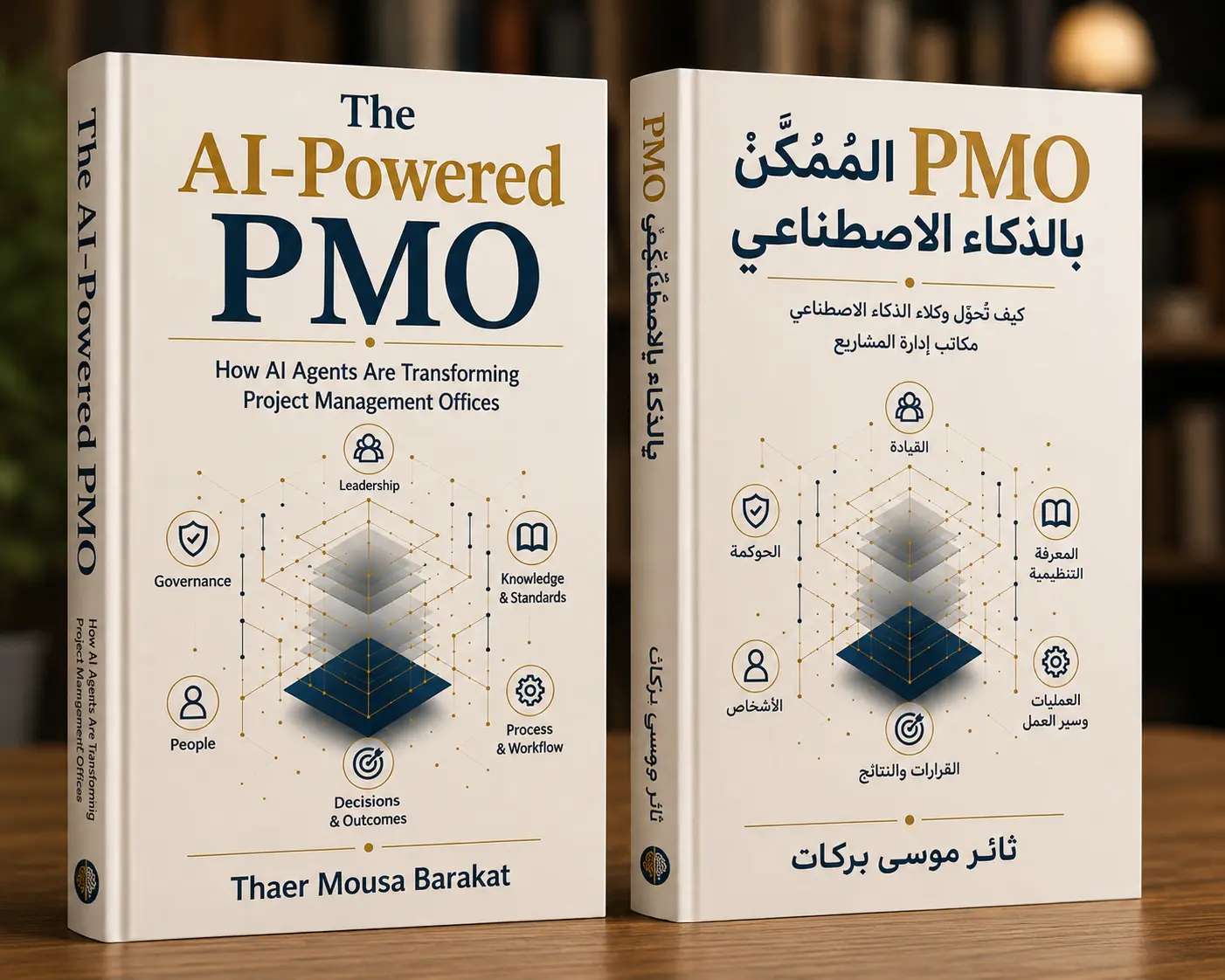
Abstract claims about AI are cheap, so let me be concrete about the architecture. In my book The AI-Powered PMO, and in the course built alongside it, I describe a working structure of six specialised agents. Each has a defined role, defined inputs, and defined boundaries. Together they form the administrative engine of the PMO, operating under human governance.
The Portfolio Coordinator
Maintains the live picture of the portfolio. It tracks status across projects, reconciles inconsistencies between sources, and keeps a single, current view of where everything stands. It is the answer to the question every PMO analyst dreads on a Friday afternoon: what is the actual state of the portfolio right now?
The Scheduler
Works across project plans rather than within one. It watches dependencies, milestone movements, and resource allocations across the portfolio, and it surfaces conflicts while they are still forecasts rather than facts. Cross-project scheduling is precisely the kind of many-variables problem that humans handle poorly under time pressure and machines handle well continuously.
The Risk Agent
Monitors delivery signals for the patterns that precede trouble: slipping velocity, rising change requests, budget consumption outpacing progress, key roles going unfilled. It does not decide what is a risk. It ensures that nothing that looks like one goes unexamined.
The Knowledge Agent
Addresses one of the oldest failures in project delivery: organisational amnesia. Lessons learned are captured, filed, and never consulted again. A knowledge agent makes prior experience retrievable at the moment of decision, so that a team scoping a new integration programme can actually benefit from the three previous ones the organisation delivered.
The Reporting Agent
Generates the outputs that used to consume the PMO's week. Status packs, portfolio summaries, variance reports, each drawn from live data and produced in minutes rather than days. The significant change is not speed. It is that reporting stops being a periodic event and becomes an available service.
The Executive Briefing Agent
Sits at the top of the stack. It translates portfolio detail into the form executives need: what changed, what matters, what requires a decision, and what happens if the decision is deferred. It is the difference between giving leadership a data dump and giving them a briefing.
Two things about this architecture deserve emphasis. First, these are specialised agents with narrow mandates, not one general assistant asked to do everything. Specialisation is what makes the system governable. Second, every agent produces inputs to human judgement, not substitutes for it. Which brings us to the most important section of this article.
Human Decisions Stay Human
Any serious discussion of AI in a governance function has to confront the question of authority, and the answer needs to be unambiguous.
AI agents propose. Humans decide. That is not a temporary caution to be relaxed as the technology matures — it is a permanent design principle.
The organisations that treat it as such will be the ones whose AI-powered PMOs survive their first serious incident. The reasoning is straightforward. A PMO is a governance function. Its authority rests on accountability, and accountability cannot be delegated to a system that cannot be held responsible. An agent can flag that a programme's trajectory implies a three-month delay. Only a human can weigh that against the commercial commitments, the political context, and the credibility of the team making the recovery plan, and then own the consequences of the call.
Governance Artefacts the AI-Powered PMO Needs
Most AI pilots skip these. A governance-ready PMO does not.
- Explicit boundaries on what agents may access and produce
- Escalation paths for when automated analysis and human judgement disagree
- Audit trails that make every agent-generated input traceable
- Clear ownership of every decision the system informs
I have written before about governance as an operating model rather than a policy document. Nowhere does that principle matter more than here, where the AI sits inside the function that is supposed to embody governance for everyone else.
A Note for GCC Executives
Regional regulators and boards are moving quickly on AI accountability. A PMO that can demonstrate exactly where automated analysis ends and human authority begins will find that capability turning up in procurement conversations sooner than expected.
The Real Benefits, Stated Honestly
Vendor material on AI in project management leans heavily on efficiency multiples. Fifty percent faster reporting, seventy percent less administrative effort. Some of those numbers are even true. But they miss what actually matters, because the point of the transformation is not to produce the same reports faster.
The benefits that change how organisations run are operational, and they compound.
Visibility arrives earlier. Risks and conflicts surface when they are still cheap to address. The gap between something becoming true and leadership knowing it is true shrinks from weeks to hours.
Reporting becomes continuous. The portfolio picture is always current, which quietly kills an entire category of meeting whose only purpose was to establish what the current picture is.
Surprises become rarer. Not because delivery becomes easier, but because deterioration is detected while it is still a trend rather than an event.
Governance becomes consistent. Every project is assessed against the same criteria, on the same cadence, without depending on which analyst compiled the pack or how much time they had.
And executive information becomes decision-ready. Leadership receives analysis shaped around choices, not data shaped around templates.
The compound effect is a change in the PMO's standing. A function that consistently tells leadership things they did not already know, earlier than they expected to know them, is not overhead. It is infrastructure.
What Organisations Need First
Here is where I will disappoint anyone hoping to buy their way into this with a licence agreement. The organisations that struggle with AI-powered PMOs do not struggle because of the AI. They struggle because of what the AI is pointed at.
An agent monitoring portfolio health is only as good as the project data it monitors. If status lives in disconnected spreadsheets, if "complete" means different things on different programmes, if financial actuals arrive six weeks after the fact, then automation will simply surface the inconsistency faster. That has some value, but it is not transformation.
Four foundations matter more than any tool selection.
Standardised Project Information
Common definitions of status, milestones, risk severity, and completion, applied across the portfolio. This is unglamorous work, and it is the single strongest predictor of whether the agents produce insight or noise.
Clear Data Ownership
Someone must be accountable for the accuracy of what the agents consume. Ambiguity here does not disappear under automation. It gets amplified.
A Governance Framework
Established before deployment rather than retrofitted after the first incident. Boundaries, escalation, auditability, decision rights.
An Honest Maturity Assessment
In the book I set out a five-level maturity model for exactly this purpose, because the appropriate next step for a PMO drowning in manual consolidation is very different from the next step for one that already has clean, centralised portfolio data. Organisations tend to overestimate their level by one. Starting from an honest baseline is cheaper than discovering it mid-deployment.
None of this should be read as a reason to wait. It should be read as the actual project plan. The foundations are achievable in months, not years, and they pay for themselves even before an agent is deployed.
The Window Is Open Now
Every operating model shift has a period when moving early confers a durable advantage, and this one is in that period now.
The technology is production-ready. The practices are established enough to adopt without pioneering risk, and new enough that adopting them still differentiates. In the GCC especially, where national programmes have made delivery capability a strategic priority and where portfolios are large, fast-moving, and highly visible, the PMOs that establish AI-supported operating models in the next two years will define what the standard looks like for the region.
The PMOs that wait will eventually adopt the same tools. But they will adopt them defensively, under pressure, into functions whose credibility has already eroded, and they will be catching up to a standard someone else set.
The future PMO will not manage more spreadsheets. It will manage an ecosystem of specialised AI agents working under human leadership, and it will spend its recovered capacity on the work the function was always meant to do: judgement, governance, and better decisions made sooner.
That future is not a prediction. In the organisations moving first, it is already the operating model. The only open question is where your PMO will be standing when it becomes everyone's.
The AI-Powered PMO is available now on Amazon in English and Arabic. A companion course covering the six-agent architecture and the five-level maturity model is available in English and Arabic. Request preview access at learn.theflowminds.com.